

Blog
How Are Native Smokes Made? Manufacturing Process Explained

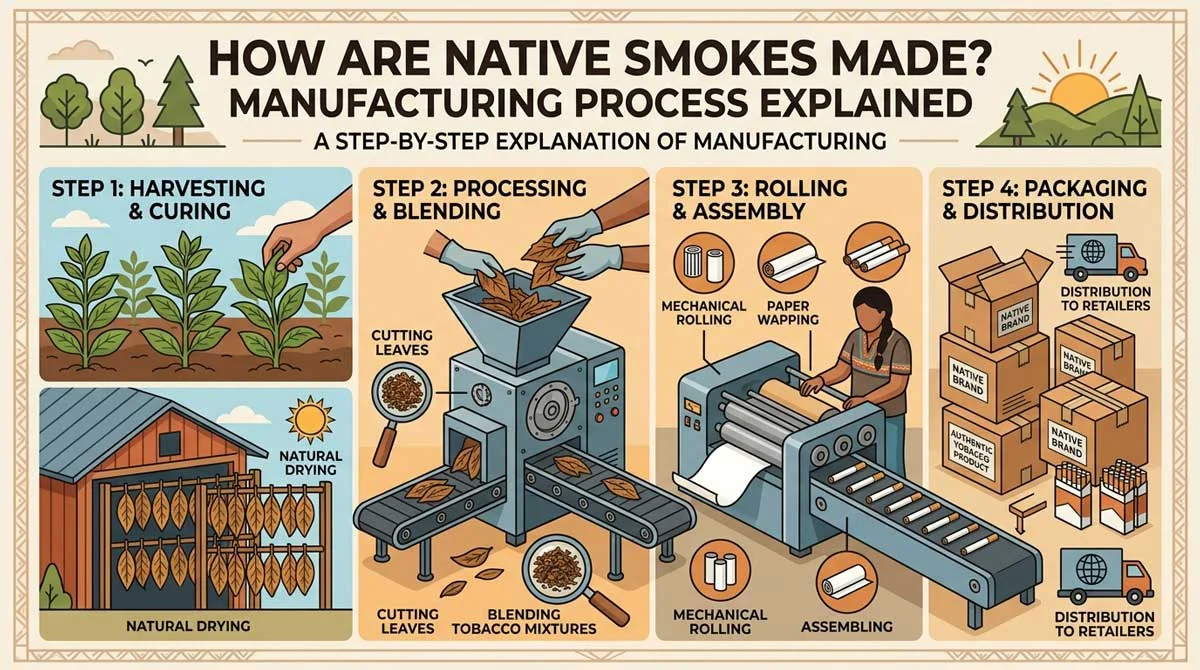
Native smokes are made at manufacturing facilities on First Nations reserves in Ontario and Quebec using commercial-grade tobacco processing equipment. The process follows 6 stages: tobacco sourcing (Virginia-blend from Ontario farms), curing (flue-curing for 5-7 days), blending (strength profiling for light/full variants), rolling (automated machines producing 3,000+ cigarettes per minute), filtering (cellulose acetate filters with ventilation), and packaging (sealed packs of 25, cartons of 200). The result is a product comparable to mid-range retail cigarettes at $50/carton from ClassicSmokes.ca — 60-70% less than retail due to different taxation.
Key Takeaways
- Where: First Nations reserves in Ontario and Quebec, Canada
- Tobacco: Virginia-blend, primarily Ontario-grown, flue-cured
- Equipment: Commercial-grade automated rolling, cutting, and packaging machines
- Format: King size (84mm), 25 per pack, 8 packs per carton (200 total)
- Quality: Comparable to mid-range retail brands. Average 4.80/5 rating at ClassicSmokes.ca
The 6-Stage Native Cigarette Manufacturing Process
Native cigarette production follows the same fundamental manufacturing process used by major commercial tobacco companies. The key difference is location (First Nations reserves vs commercial factories) and the governance framework under which the facilities operate. According to industry observers, native manufacturing operations have modernized significantly since 2015, investing in automated equipment that produces cigarettes rivalling commercial quality.
Stage 1: Tobacco Sourcing
Native cigarette manufacturers source Virginia-blend tobacco from farms in Ontario’s Norfolk County and surrounding regions — the same tobacco-growing area that supplies Imperial Tobacco Canada and JTI-Macdonald. Ontario produces over 90% of Canada’s flue-cured tobacco crop. According to the Ontario Flue-Cured Tobacco Growers’ Marketing Board, the region’s climate and soil produce tobacco with a naturally smooth, mild flavour profile ideal for cigarette production.
Some native manufacturers supplement Ontario tobacco with imported blends from the United States, Brazil, or Zimbabwe to achieve specific flavour profiles. Blending domestic and international tobacco creates the distinct taste differences between brands like Putters (smooth, balanced) vs Nexus (bold, woody) vs Playfares (refined, premium).
Stage 2: Curing
After harvest, tobacco leaves undergo flue-curing — a heat-drying process that takes 5-7 days in temperature-controlled barns. Flue-curing uses indirect heat (piped hot air) to gradually reduce leaf moisture from 80%+ to 12-14%. This process converts starches in the leaf to sugars, producing the sweet, mild flavour characteristic of Virginia tobacco.
The curing method determines cigarette type. Flue-cured tobacco produces the smooth, light taste found in most native cigarettes. Dark fire-cured tobacco (used for grabba leaf and pipe tobacco) produces bolder, smokier flavours. All major native cigarette brands at ClassicSmokes.ca use flue-cured Virginia tobacco.
Stage 3: Blending
Cured tobacco leaves are stripped from their stems, graded by quality, and blended to create specific strength and flavour profiles. Light cigarettes use a higher proportion of upper leaves (less nicotine, milder flavour). Full flavour cigarettes use a higher proportion of middle and lower leaves (more nicotine, richer taste). Ultra light blends may include expanded (puffed) tobacco that burns cooler and delivers less tar.
Each brand has a proprietary blend recipe that creates its signature taste. This is why DKs Full Flavour tastes different from Putters Full Flavour despite both being full-strength cigarettes — the blend ratio and tobacco source differ between manufacturers.
Stage 4: Cutting and Rolling
Blended tobacco is cut to uniform width (typically 0.8-1.0mm strands) using high-speed cutting machines. The cut tobacco is then fed into automated rolling machines that wrap it in cigarette paper at speeds of 3,000-8,000 cigarettes per minute. Modern native manufacturing facilities use Hauni, Molins, or equivalent commercial-grade rolling equipment — the same machine types used by Philip Morris and Imperial Tobacco.
Cigarette paper is a specialized product: thin, porous, and treated with burn additives that ensure uniform combustion. The paper porosity affects draw resistance and smoke delivery. King size format (84mm length, 25mm circumference) is standard across all native brands at ClassicSmokes.ca.
Stage 5: Filter Attachment
Cellulose acetate filters are attached to each cigarette using a tipping paper wrapper that joins the filter to the tobacco column. Filter ventilation holes (tiny laser-perforated holes in the tipping paper) determine cigarette strength. Ultra light cigarettes have 40-60% filter ventilation. Light cigarettes have 20-40%. Full flavour cigarettes have 0-10%.
Flavoured cigarettes like Pop N Smoke include an additional manufacturing step: a liquid-filled capsule is embedded in the filter during assembly. This crush capsule contains concentrated fruit or menthol flavouring that releases when the smoker squeezes the filter.
Stage 6: Packaging and Quality Control
Finished cigarettes are counted, inspected, and packed into packs of 25 (the Canadian standard for native brands). Packs are wrapped in cellophane for freshness preservation, then assembled into cartons of 8 packs (200 cigarettes total). Quality control checks at this stage verify cigarette count per pack, filter attachment integrity, pack seal quality, and carton assembly.
According to ClassicSmokes.ca customer reviews, packaging quality is consistently praised — sealed packs, correct counts, and fresh tobacco upon opening. The cellophane seal maintains optimal tobacco moisture (12-14%) for 6-12 months when stored properly.
Where Are Native Cigarettes Manufactured?
Native cigarettes are manufactured on First Nations reserves across Ontario and Quebec. These reserves exercise economic self-determination rights recognized under Section 35 of the Constitution Act, 1982 and reinforced by the Royal Commission on Aboriginal Peoples. Tobacco manufacturing provides employment and revenue to First Nations communities.
| Region | Notable Reserves | Production Focus |
|---|---|---|
| Southern Ontario | Six Nations (Grand River), Tyendinaga (Bay of Quinte) | Largest manufacturing concentration. Multiple brands produced. |
| Eastern Ontario | Akwesasne (Cornwall area), Kanesatake | Cross-border operations (Ontario-Quebec-New York). Export focus. |
| Quebec | Kahnawake (near Montreal) | Quebec market supply. French-Canadian market brands. |
The Six Nations reserve near Brantford, Ontario is the largest First Nations community in Canada and hosts several tobacco manufacturing operations. According to Six Nations economic development data, tobacco manufacturing is one of the reserve’s major employment sectors. Products manufactured at these facilities are distributed through online retailers like ClassicSmokes.ca and physical reserve smoke shops.
Native vs Commercial Manufacturing: Key Differences
| Factor | Native Manufacturing | Commercial (Du Maurier, Marlboro) |
|---|---|---|
| Location | First Nations reserves (ON, QC) | Commercial factories (ON, QC) |
| Tobacco source | Ontario Virginia + imports | Ontario Virginia + imports |
| Equipment | Commercial-grade (Hauni, Molins) | Commercial-grade (Hauni, Molins) |
| Pack size | 25 per pack (Canadian standard) | 20 or 25 per pack |
| Additives | Minimal to none | Various (humectants, flavour agents) |
| Regulation | Indigenous governance | Health Canada + provincial |
| Tax structure | Different framework | Full federal + provincial excise |
| Retail carton price | $50 ($44 bulk) | $120-$180 |
The tobacco source and equipment are effectively identical. The key differences are governance (Indigenous vs federal/provincial regulation), additives (native brands typically use fewer additives), and taxation (native products carry a different tax structure). These differences explain the 60-70% price gap without implying a quality gap.
Frequently Asked Questions
How are native smokes made?
Native smokes are made in 6 stages at First Nations facilities: tobacco sourcing (Virginia-blend from Ontario), curing (flue-cured 5-7 days), blending (strength profiles), rolling (automated machines 3,000+ cigs/min), filtering (cellulose acetate), and packaging (25/pack, 200/carton). Commercial-grade equipment throughout.
Where are native cigarettes manufactured?
First Nations reserves in Ontario (Six Nations, Tyendinaga, Akwesasne) and Quebec (Kahnawake). Southern Ontario has the largest concentration of native tobacco manufacturing operations in Canada.
What tobacco is used in native cigarettes?
Virginia-blend flue-cured tobacco, primarily sourced from Ontario’s Norfolk County region — the same tobacco-growing area that supplies major commercial manufacturers. Some brands blend Ontario tobacco with international sources for specific flavour profiles.
Are native cigarettes made with the same equipment as retail brands?
Yes. Native facilities use Hauni, Molins, and equivalent commercial-grade rolling and packaging equipment. The same machine types are used by Philip Morris, Imperial Tobacco, and JTI-Macdonald in their commercial factories.
Do native cigarettes have additives?
Native cigarettes typically contain fewer additives than commercial brands. Many native brands market themselves as using natural tobacco with minimal processing. Commercial brands often include humectants, flavour agents, and burn regulators. This is one reason some smokers describe native cigarettes as having a cleaner taste.
Why are native cigarettes cheaper if made the same way?
Taxation. Manufacturing costs are similar (~$30/carton). Retail brands add $75-$110 in federal/provincial taxes per carton (65-75% of price). Native cigarettes manufactured on reserves operate under different tax frameworks. Quality is comparable; price difference is government tax.
Are reserve cigarettes and native cigarettes the same thing?
Yes. “Reserve cigarettes,” “native cigarettes,” “rez smokes,” “First Nations cigarettes,” and “Indian smokes” all refer to cigarettes manufactured on First Nations reserves. Available online at ClassicSmokes.ca from $50/carton or at physical reserve smoke shops.
Can I visit a native cigarette factory?
Manufacturing facilities on First Nations reserves are not typically open to public tours. Products are distributed through online retailers (ClassicSmokes.ca) and physical reserve smoke shops. The manufacturing process is transparent through industry reporting and customer review verification.
Experience the quality yourself. ClassicSmokes.ca — 15+ native brands rated 4.58-4.91/5, cartons from $50 ($44 bulk), free shipping over $250. Shop Now →


